Landlord and Tenant Responsibilities: A Local-Law Framework
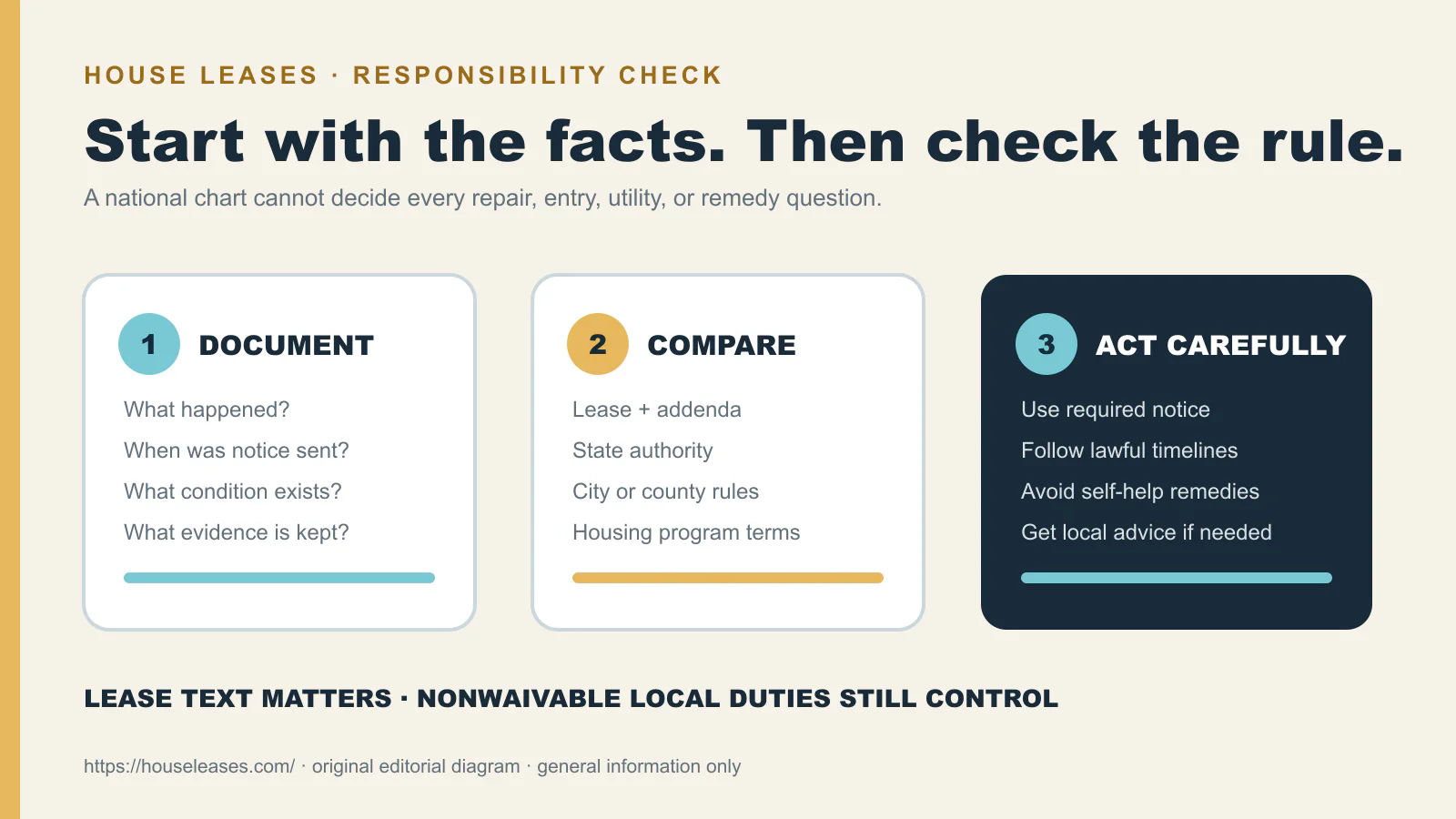
Image: House Leases
Legal source check: 27 July 2026. Residential rental rules vary by jurisdiction and housing program.
Who handles a repair, utility, pest issue, appliance, yard, or safety device cannot always be answered from a national chart. The lease matters, but state and local law may impose duties or remedies that a contract cannot waive.
Use USAGov’s tenant-rights directory to locate the current authority for the state where the property sits. City or county rules may add another layer.
Federal rules to check first
Federal law does not create one complete landlord-tenant code, but several federal protections can apply:
- The Fair Housing Act governs discrimination in housing-related activities.
- The EPA describes lead-based-paint disclosure duties for most pre-1978 housing.
- The Department of Justice explains housing protections under the Servicemembers Civil Relief Act.
Housing-assistance programs and federally connected properties may have additional rules.
Questions usually controlled by state or local law
Check the governing law before making a categorical statement about:
- habitability and essential services;
- smoke or carbon-monoxide devices;
- locks and security requirements;
- notice before landlord entry;
- security-deposit handling and deadlines;
- rent withholding or repair-and-deduct remedies;
- pest responsibility;
- eviction notices and procedures;
- responsibility after casualty, mold, water intrusion, or code violations.
There is no safe nationwide default such as “24 hours is always enough notice.â€
A responsibility worksheet
Use the table as a list of questions, not as an answer key:
| Topic | Facts to document | Rule to verify |
|---|---|---|
| Repair request | Date, condition, photos, access offered | Local repair and habitability law |
| Appliance | Ownership, cause, lease term | Lease plus nonwaivable local duties |
| Water leak | Source, notice, mitigation, damage | Local law, insurance, and lease |
| Pest issue | Timing, extent, property condition | Local health/housing code and lease |
| Yard or pool | Exact recurring tasks and provider | Local safety rules and lease |
| Entry | Purpose, urgency, proposed time | Local notice and access law |
| Deposit | Amount, condition records, deductions | State/local deposit law |
Avoid deciding responsibility solely from who first noticed a problem. Cause, notice, access, property condition, applicable law, and the lease can all matter.
A safer issue-resolution process
- Document the condition. Record dates, messages, photographs, and relevant lease language.
- Address immediate safety. Follow emergency instructions and contact appropriate emergency or utility services when necessary.
- Send notice through the required channel. Keep a copy.
- Check the governing rule. Use the state or local housing authority, code office, legal-aid organization, or qualified lawyer.
- Do not improvise a remedy. Withholding rent, deducting repairs, entering, shutting off services, or changing locks can have serious consequences if local procedures are not followed.
Put operational details in writing
The lease can reduce uncertainty by stating contacts, reporting methods, agreed routine tasks, emergency procedures, and documentation expectations. It should not claim to erase statutory duties.
Key takeaway
Treat responsibility as a three-part question: what happened, what the lawful lease says, and what current state and local law requires.
General legal information only, not legal advice or a statement of law for any specific property.
landlord responsibilitiestenant rightsrepairshabitabilityleasing